


Research Axes
The Canadian Philanthropy Partnership Research Network (PhiLab) is a collaborative center of expertise dedicated to the study of philanthropy in Canada and Quebec. It is the result of a collaboration between researchers from various Canadian universities and representatives of the philanthropic ecosystem.
The PhiLab Network’s scientific program is structured around four main areas that frame the analysis of contemporary transformations in philanthropy in their theoretical, institutional, social, and environmental dimensions. These areas constitute a coherent analytical framework for examining the dynamics of the sector in a context of social and ecological transitions, while articulating different levels of analysis.
They are complemented by three cross-cutting areas—macro, meso, and micro—that promote an integrated approach, attentive to methods, organizational practices, and citizen behavior. This overall structure reflects the multidisciplinary nature of PhiLab’s researchers and partners, as well as the desire to combine theoretical, empirical, and experiential perspectives in order to renew knowledge and practices within the philanthropic ecosystem.
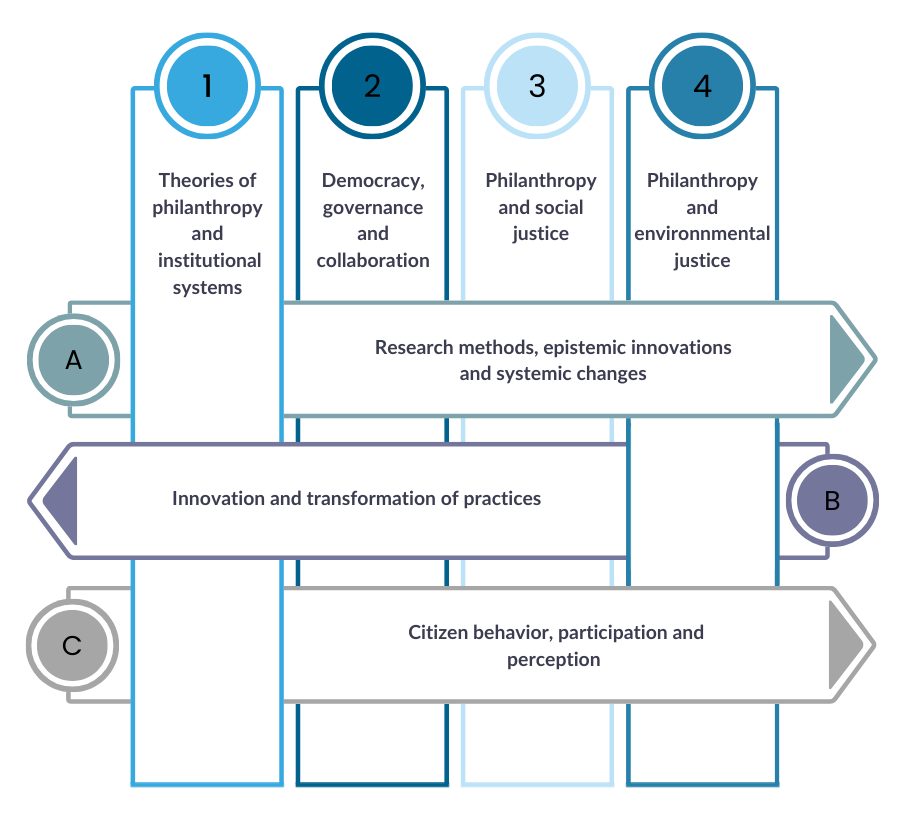
Primary research axes
Axis 1 – Theories of philanthropy and institutional systems
Objective of this axis: To understand the foundations, roles, and transformations of philanthropy in relation to the institutional systems that structure it, in a context of social and ecological transition.
Keywords: history, regulation of donations, non-profit law, taxation, governance and management of organizations, political economy and sector strategies, philanthropic foundations and institutional systems
Axis 2 – Democracy, governance, and collaboration
Objective of this axis: To study the mechanisms of coordination, cooperation, and governance that structure relations between foundations, non-profits, social movements, public and private actors, and academia, in order to strengthen the sector’s coherence and collective capacity.
Keywords: civil society, social movements, resistance, populism, nationalism, role of journalism and local news, corporative philanthropy, citizen participation and collective engagement
Axis 3 – Philanthropy and social justice
Objective of this axis: To study the strategies, innovations, and effects of philanthropic actions aimed at reducing social injustices, redistributing power, and supporting community self-determination.
Keywords: inequalities, poverty, vulnerability, raciality, coloniality, DEI, systems of oppression, environmental health and social impacts, socio-ecological justice, and transitions
Axis 4 – Philanthropy and environmental justice
Objective of this axis: Analyze philanthropic responses to the ecological crisis, their impacts, limitations, and contributions to environmental and climate transition.
Keywords: climate change, rurality, territorial governance, environmental geopolitics, agriculture, food systems, and food security
Transversal research axes
Axis A – (Macro) Methods, epistemic innovations, and systemic changes
Objective of this axis: Develop and test innovative methodologies (participatory, partnership-based, qualitative, mixed) to analyze a rapidly changing sector and renew ways of producing and using knowledge.
Keywords: partnership research, co-construction of knowledge, interdisciplinarity, knowledge mobilization, action research, experimentation, knowledge valorization, experiential knowledge
Axis B – (Meso) Innovation and transformation of practices
Objective of this axis: Document the structure, dynamics, and innovative and transformative practices of the philanthropic ecosystem according to sectors, regions, communities, and organizational configurations.
Keywords: social finance, impact investing, community philanthropy, community wealth building, organizational innovation, leadership, management practices
Axis C – (Micro) Citizen behaviour, participation, and perception
Objective of this axis: Analyze citizen behaviour and perceptions of philanthropy in their interactions with philanthropic mechanisms and societal issues.
Keywords: informal philanthropy, citizen participation, responsible consumption, new forms of giving, social marketing, volunteering, public engagement and motivations