


Transforming the Relationship Between Funders and Funded Organizations in Philanthropy: An Action Research Approach to Collaboration, Flexible Funding, and Dialogic Evaluation
Research summary
Justification of research project
This approach to knowledge generation stems from a unique situation: the integration of a research and knowledge mobilization function at the very heart of a collaborative philanthropic project. The Collective Impact Project is a philanthropic, community-based, and institutional partnership that supports collective action to combat poverty and social exclusion in Montreal’s neighborhoods. What sets it apart is its commitment to reversing several funding paradigms: communities themselves identify needs and choose the issues and strategies; relationships between funders and funded groups are becoming more horizontal, with a focus on streamlining accountability, fostering dialogue, and increasing collaboration.
This is precisely what connects the research to the CIP’s fieldwork. The central theme focuses on the ways in which actors with different experiences, knowledge, and perspectives can engage in dialogue and develop collective responses. Underlying this question are broader concerns about social justice and the democratization of knowledge: how to enable processes in which a plurality of voices can contribute to decisions and in which different types of knowledge are recognized and mobilized. The CIP provides a context where these questions arise in concrete terms, by bringing together a diverse range of stakeholders around a funding program that aims for systemic change and evolves as a result of collective learning.
These are not, therefore, research projects conducted within the framework of the program, but rather knowledge initiatives that emerge from a flexible, experimental program open to learning. Knowledge is produced and mobilized in collaboration with the stakeholders involved, through an action-research approach focused on the democratization of knowledge and epistemic justice—documenting impacts and understanding challenges and levers without reproducing an extractivist logic. The research function is thus integrated into the project, but it is not focused solely inward: while it aims first and foremost to refine practices and the program itself, it seeks just as much to contribute to knowledge and practices regarding collective action and ways to support it, beyond the scope of the CIP.
Research question
How can we transform the relationship between funders and grantees to make it more horizontal and reciprocal—and what concrete results does such a transformation yield, both for communities and for philanthropic practices themselves?
This issue has three aspects that are continuously addressed:
1. Collaboration among different types of stakeholders. This is a cross-cutting dimension that overlaps with the other two. How can we further advance collaboration among philanthropic, community, and institutional stakeholders? What are its limitations? This dimension includes the co-development of non-financial support—mobilizing networks, expertise, and levers of influence beyond funding. It also encompasses the issue of the role and engagement of institutions.
2. Flexible funding. What are the specific strengths and limitations of less restrictive funding practices? What they enable—adaptability, strategic alignment, experimentation—and what they do not address, particularly the structural underfunding of the community sector. The question of transferring these practices to other funders is central.
3. Evaluation and Learning. How can we document the impacts of a collective effort without resorting to extractivism? How can we shift evaluation practices toward a more dialogic approach and make learning a true driver for adjusting practices and the program?
Research purpose
The internal research component is led by a research team to which several students and research professionals have contributed since 2021: Yannick Sanschagrin, Mariane Rail, Cassandre Ville, Éric Joly, and Raphaëlle de Albuquerque (for the Phase 1 evaluation, between 2021 and 2024); Joris Arnaud, Clara Alagy, and Shaima Jorio (for the Phase 2 evaluation). This work is carried out in close collaboration with the project coordination team (Rotem Ayalon, Claudia Santillana, and Isabel Heck).
Individuals from the community, institutional, philanthropic, and research sectors form an evaluation and learning committee that is involved in all aspects of the project’s evaluation. Since 2021, the following individuals have served on the committee: Joris Arnaud (Centraide of Greater Montreal), Jessyca Cloutier (City of Montreal), Marie-Caroline Juneau (McConnell Foundation), Sylvain A. Lefèvre (UQAM), Judikaëlle Marterer (Faubourg Saint-Laurent Roundtable), Sagesse Miekountima (Un itinéraire pour tous), Annie Montcalm-Cardinal (Centraide of Greater Montreal), Éléonord Robert-D’Amour (CDC Centre-Sud), and Patricia Rossi (Lucie and André Chagnon Foundation). In addition, there have been ad hoc collaborations, notably with Gabriel Salathé-Beaulieu (TIESS) for the initiative on flexible funding.
These initiatives have had tangible effects on the program and on practices:
• An assessment approach that has become dialogic. Assessment practices have evolved into a co-constructed process based on dialogue and reciprocity, developed in response to the diversity of the partners’ interests and constraints.
• A direct contribution to the design of Phase 3. The midterm review made five recommendations that informed the collaborative process for determining next steps.
• A regional initiative on flexible funding. The CIP launched a collective initiative aimed at strengthening these practices at the regional level, which led to the report produced in collaboration with TIESS and subsequently to a dialogue with other donors—including a webinar and a workshop on sharing best practices.
• Increased exchange of best practices among neighborhoods and beyond, with a focus on reciprocity, where not only neighborhoods but also foundations share their best practices.
Research approach
Knowledge generation is integrated across all aspects of daily work rather than conducted in parallel. Led by the research team, it draws on ongoing exchanges between the CIP coordination team and community, institutional, and philanthropic stakeholders, who play a key role in both identifying lessons learned and integrating them into practice. Specifically:
-
The activities build on the CIP’s existing platforms—governance bodies, follow-up meetings with neighborhoods, events, and exchanges of best practices: the discussions that take place there fuel learning, generate data, and facilitate the exchange of perspectives, without overburdening stakeholders with a parallel evaluation process.
-
The Evaluation and Learning Committee contributes to every stage of the process: reviewing data, responding to preliminary findings, conducting in-depth analyses, and developing recommendations. Through discussions with external researchers, it provides an outside perspective on an internally conducted initiative.
-
Several times a year, best-practice exchanges and an annual Learning Forum help broaden the sharing of knowledge—the November 2025 event brought together nearly 85 people from neighborhoods, foundations, institutions, and the Montreal Coalition of Neighborhood Councils.

Partners members

- Projet impact collectif (PIC), Centraide du Grand Montréal, en partenariat avec des fondations philanthropiques, la Coalition montréalaise des tables de quartier, la Ville de Montréal et la Direction régionale de santé publique.
Research project reports and publications
-

Webinar : The experience of flexible funding at Projet impact collectif.
22 janvier 2026, 11h-12h30 (HNE)
A discussion in French with simultaneous translation subtitles -
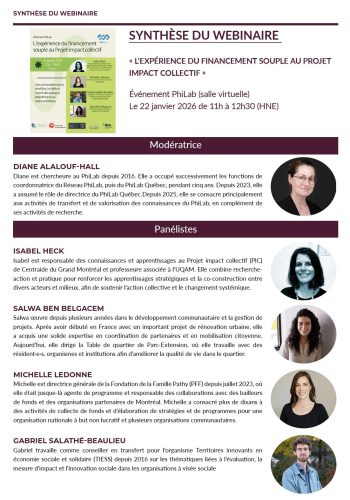
Summary of the webinar “The experience of flexible funding at the Collective Impact Project”
Published on February 23 2026
Découvrez d’autres publications en lien avec le Projet impact collectif
- Bilans de phase : Innover et apprendre pour mieux soutenir la lutte contre la pauvreté dans les quartiers montréalais — bilan du Projet impact collectif Phase 1, Les Cahiers du CRISES (2023); Le PIC en mouvement : ce qu’on apprend de la phase 2 — bilan mi-parcours (2025)
- Plan d’évaluation et des apprentissages, phase 2 (2024)
- Fiches synthèse d’apprentissages destinées aux personnes engagées dans des initiatives collectives
- « Le potentiel transformateur de la collaboration : apprentissages du Projet impact collectif à Montréal », The Philanthropist Journal
- Webinaires et séminaires, dont le webinaire PhiLab « L’expérience du financement souple au Projet impact collectif » (janvier 2026) et l’atelier d’échange de pratiques entre bailleurs de fonds qui a suivi
- Carrefour des apprentissages annuel (2024, 2025) et carnets d’apprentissage (publication prévue au printemps 2027)